

When it comes to protecting your family’s financial future, choosing the right life insurance is one of the most important decisions you will ever make. And if you have been searching for clarity on term insurance vs whole life insurance, you are in the right place. Millions of Indians pay insurance premiums every year without fully understanding what they are paying for — and that single mistake can cost your family lakhs of rupees. In this complete guide, you will find everything you need to know, in plain language, so you can make a confident and informed choice in 2026.
Understanding the difference between term insurance vs whole life insurance is not just a financial decision — it is a decision that directly affects your family’s security for the next 20–30 years.
Why Choosing the Right Life Insurance Matters More in 2026
India’s insurance penetration is still below the global average. According to data from the Insurance Regulatory and Development Authority of India (IRDAI), life insurance penetration in India stood at just around 3.2% of GDP — far below developed nations. What this tells you is that a large number of Indian families are still underinsured or covered by the wrong kind of policy.
In 2026, with rising inflation, growing healthcare costs, and increasing awareness about financial planning, it has become more important than ever to understand what you are signing up for when you buy a life insurance policy. Whether your goal is pure protection, wealth building, or both — your choice between term insurance and whole life insurance will shape your financial plan for the next several decades.
So let us break it all down, step by step, in a way that actually makes sense for your life and your money.
What Is Term Insurance? A Simple Explanation
Term insurance is the simplest and most affordable form of life insurance available in India. When you buy a term plan, you are paying a premium to secure a fixed sum assured (your life cover) for a specific number of years — your policy term. If you pass away during this period, your family receives the entire sum assured as a death benefit. If you survive the full policy term, the coverage ends and you receive nothing back — unless you have opted for a Return of Premium (ROP) rider.
Key Features of Term Insurance
Here is what makes term insurance stand out as a protection tool for your family:
- Pure protection: Your premium buys you maximum life cover at minimum cost. There is no savings or investment component bundled in.
- Low premiums: A healthy 30-year-old non-smoker can get a ₹1 crore cover for as little as ₹700–₹900 per month in 2026.
- High sum assured: Because the insurer is only paying if you die, they can afford to offer very large covers at affordable rates.
- Fixed policy term: You choose a coverage period — typically 20, 30, or 40 years — based on your financial goals and dependents’ needs.
- Tax benefits: Premiums paid qualify for deduction under Section 80C of the Income Tax Act, and death benefits are tax-free under Section 10(10D).
Who Should Buy Term Insurance?
Term insurance is the right choice for you if:
- You are the primary income earner in your family
- You have financial dependents — a spouse, children, or aging parents
- You have outstanding liabilities like a home loan, car loan, or business debt
- Your goal is maximum protection at minimum cost
- You want to understand exactly how term insurance vs whole life insurance differs before committing your premium budget.
Financial experts, including most SEBI-registered advisors and AMFI-registered distributors, widely recommend term insurance as the foundation of any sound financial plan. As Manjit Singh (ARN-A278291), an AMFI-registered Mutual Fund Distributor, always advises clients — your life cover should be at least 10–15 times your annual income, and a pure term plan is the most efficient way to achieve that.
What Is Whole Life Insurance? Understanding the Full Picture
Whole life insurance, as the name suggests, covers you for your entire lifetime — typically up to 99 or 100 years of age. Unlike term insurance, it combines a death benefit with a savings or cash value component. Part of your premium goes toward your life cover, and the remaining portion builds a cash value that grows over time, often at a guaranteed rate.
Key Features of Whole Life Insurance
- Lifelong coverage: Your beneficiaries receive the death benefit no matter when you pass away, as long as you keep paying premiums.
- Cash value accumulation: A portion of your premium builds into a savings corpus that you can borrow against or partially withdraw.
- Higher premiums: Because of the savings element and lifelong guarantee, premiums are significantly higher — often 5–15 times more than a comparable term plan.
- Maturity benefit: Many whole life policies offer a maturity benefit if you survive the premium-paying term.
- Traditional plans in India: In India, endowment plans and money-back policies sold by LIC and other insurers are broadly classified under the whole life or traditional insurance umbrella.
Who Should Consider Whole Life Insurance?
Whole life insurance may suit your needs if:
- You want guaranteed lifelong protection regardless of your health condition in old age
- You want a forced savings discipline built into your insurance premium
- You are looking for estate planning tools — leaving a legacy or wealth for the next generation
- You have already maxed out other investment options and want a low-risk, guaranteed savings vehicle
- You are a business owner who needs permanent life insurance for key-person insurance or buy-sell agreements
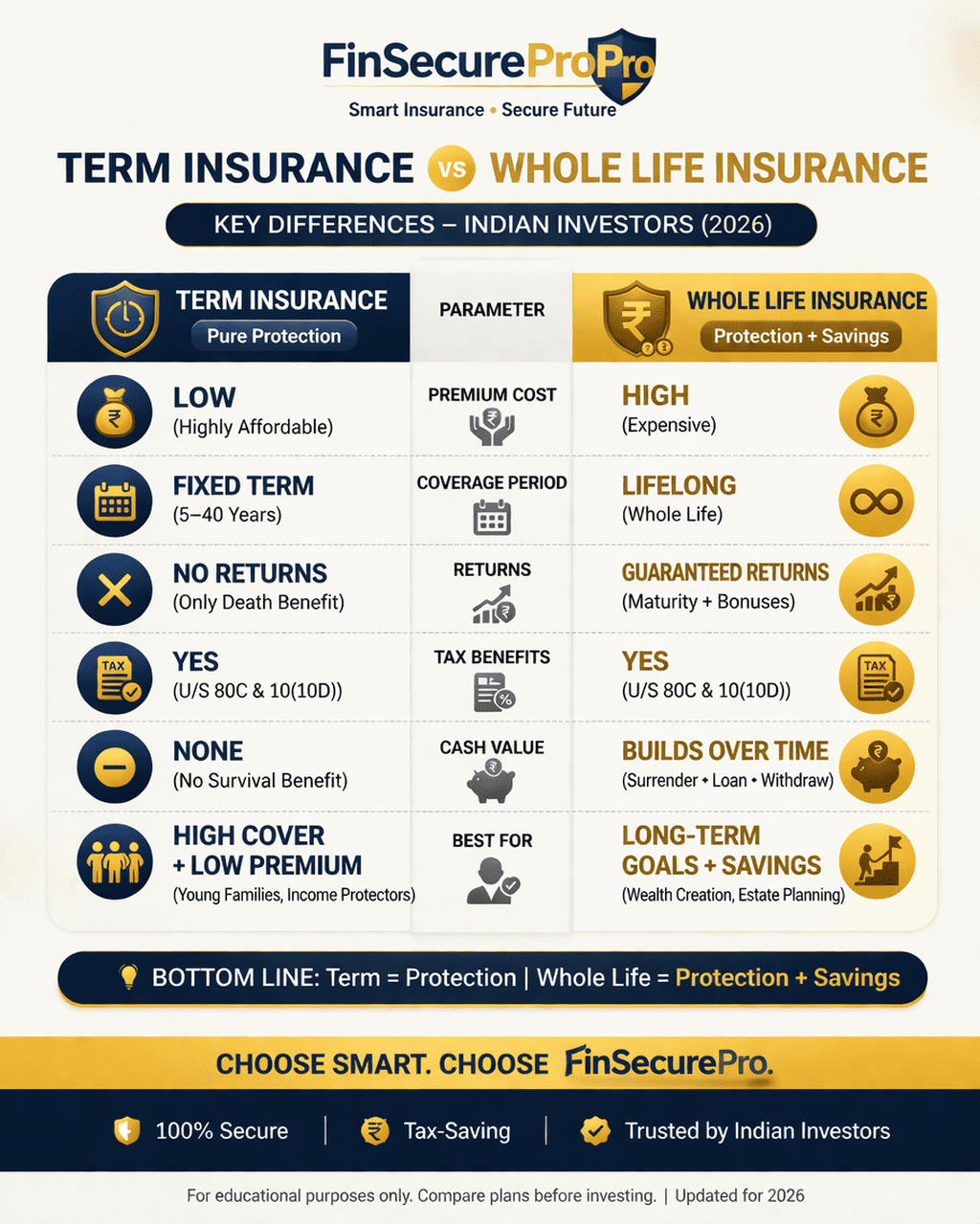
Term Insurance vs Whole Life Insurance – 7 Smart Differences You Must Know
Now that you understand the basics, let us compare term insurance vs whole life insurance across the parameters that actually matter to you as an Indian policyholder in 2026.
1. Premium Cost – What Will You Actually Pay?
This is usually the first question people ask — and rightly so.
For a 30-year-old male non-smoker seeking ₹1 crore of life cover:
- Term Insurance: Approximate annual premium = ₹8,000–₹12,000 for a 30-year policy term
- Whole Life Insurance (Traditional Endowment): Approximate annual premium = ₹60,000–₹1,20,000 for the same cover
The difference is dramatic. With term insurance, you are paying purely for risk coverage. With whole life insurance, a large chunk of your premium goes into the insurer’s savings corpus — and the returns on that corpus are typically modest (4–6% per annum for traditional LIC-style plans).
2. Coverage Period – How Long Are You Protected?
Term insurance gives you coverage for a fixed period — say 20, 30, or 40 years. After that, your coverage ends. This is perfectly fine if your financial liabilities (loans, dependents) are also time-bound.
Whole life insurance covers you for life. If your goal is ensuring a legacy payment — that your family always receives something — whole life is more aligned with that.
3. Death Benefit – What Does Your Family Actually Receive?
With term insurance, your nominee receives the full sum assured (e.g., ₹1 crore) tax-free if you pass away during the policy term.
With whole life insurance, your nominee receives the sum assured plus any accumulated bonuses. However, because the premium is so much higher, many people end up buying a much smaller sum assured — which defeats the purpose of insurance.
4. Maturity Benefit and Returns – Do You Get Money Back?
Term insurance with standard conditions gives you zero maturity benefit if you survive. However, the Return of Premium (ROP) variant does return your total premiums paid at the end of the policy term — though at a higher premium cost.
Whole life insurance does provide a maturity benefit and accumulated cash value. But here is the honest truth — the returns are generally not competitive with other investment options like ELSS mutual funds, PPF, or even NPS. You are essentially paying a premium for the guarantee.
5. Flexibility and Liquidity – Can You Access Your Money?
Term insurance has zero liquidity. You pay for protection only. But this also means you are not locked into a savings vehicle that offers poor returns.
Whole life insurance builds cash value that you can borrow against or partially surrender. This provides some liquidity — but loans against policies come with interest, and surrendering your policy midway often means significant losses.
6. Tax Benefits – How Do They Compare?
Both term and whole life insurance qualify for the same tax benefits under the Income Tax Act:
- Section 80C: Premiums paid (up to ₹1.5 lakh per year) are deductible from your taxable income
- Section 10(10D): Death benefit received by your nominee is completely tax-free
However, for whole life policies, the maturity benefit may be taxable if the premium exceeds 10% of the sum assured — a rule tightened in recent years. Always check the current IRDAI and Income Tax guidelines before purchasing.
7. Suitability – Which One Actually Fits Your Life Stage?
Here is a simple guideline based on life stage:
- Age 25–40, young family, home loan, growing career: Term insurance is almost always the better choice. You need maximum coverage at minimum cost. Invest the premium savings separately in mutual funds or PPF.
- Age 45+, loans paid off, children settled, estate planning focus: Whole life insurance may have a role — especially for legacy planning or as a low-risk savings tool if you are risk-averse.
- Business owners: Whole life insurance can be useful for specific business protection needs like key-person insurance.
The Real Cost of Confusing Insurance With Investment
One of the most common financial mistakes Indian families make is treating insurance as an investment product. Many people buy endowment plans or money-back policies thinking they will get good returns along with insurance coverage. In reality, they get neither good coverage nor good returns.
Let us look at a real-world example:
Suppose you are 30 years old and you choose a whole life endowment plan with ₹50 lakh cover, paying ₹80,000 per year for 20 years. Total premium outgo = ₹16 lakh.
At maturity (let us say at age 60), you might receive ₹22–24 lakh including bonuses. That is roughly a 5–5.5% annualised return over 30 years — barely ahead of inflation.
Alternatively, if you bought a ₹1 crore term plan at ₹10,000 per year and invested the remaining ₹70,000 per year in a diversified equity mutual fund at a conservative 12% return — you would have approximately ₹2.1 crore at the end of 20 years. And you had double the life cover through those years.
This is the “Buy Term, Invest the Difference” strategy that most certified financial planners recommend — and it is backed by decades of data.
Watch: Term Insurance vs Endowment Plan Explained (Hindi)
How to Calculate the Right Life Cover Amount for Your Family
Regardless of which type of insurance you choose, getting the right sum assured is critical. Here is how you can calculate it:
The Human Life Value (HLV) Method
Multiply your annual income by 10–15. If you earn ₹10 lakh per year, your ideal life cover should be ₹1 crore to ₹1.5 crore. This ensures your family can replace your income for 10–15 years even in your absence.
The Income Replacement Method
Calculate your family’s monthly expenses. Multiply by 12 for annual expenses. Then multiply by the number of years your family will need support (e.g., until your youngest child becomes financially independent). Add outstanding loans and subtract any existing savings or assets.
Quick Formula for 2026
- Annual income × 15 = Base cover required
- Add: Total outstanding loans and liabilities
- Add: Children’s education fund target
- Subtract: Existing savings and investments
The result gives you a realistic life cover figure. For most working professionals in India in 2026, this typically lands between ₹75 lakh and ₹2 crore.
Common Myths About Term Insurance vs Whole Life Insurance
Myth 1: “In the debate of term insurance vs whole life insurance, term is a waste because you get nothing back”
This is the most common objection — and it is also the most flawed. You do not call your car insurance a waste simply because you did not have an accident. Insurance is a risk management tool, not a savings account. The real value of term insurance is the peace of mind and financial security it gives your family during your working years.
Myth 2: “Whole Life Insurance Is Always a Better Investment”
As demonstrated in the comparison above, the returns on traditional whole life policies in India are generally modest. If you are looking for wealth creation, dedicated investment products — mutual funds, NPS, PPF — are far more efficient.
Myth 3: “I Am Young and Healthy, I Do Not Need Insurance Yet”
The younger and healthier you are when you buy term insurance, the lower your premiums will be — forever. Waiting until you are older or until health issues appear means you will pay significantly more, or you may be denied coverage altogether.
Myth 4: “Whole Life Insurance Builds Guaranteed Wealth”
The cash value in whole life insurance does grow at a guaranteed rate — but that rate is typically very conservative. For most people below 45 years of age with a long investment horizon, equity-oriented mutual funds will significantly outperform traditional insurance-linked savings over a 15–20 year period.
Top Term Insurance Plans Available in India in 2026
While I encourage you to do your own research and compare plans on official IRDA-Approved aggregator sites, here are some categories of term plans widely available in India in 2026:
Pure Term Plans (No Return of Premium)
These offer the lowest premiums and maximum life cover. Ideal for most working professionals who want pure protection. Look for plans with high claim settlement ratios (above 98%), multiple payout options (lump sum, monthly income, or both), and critical illness rider options.
Return of Premium (ROP) Term Plans
These return all premiums paid at the end of the policy term if you survive. Premiums are typically 1.5–2x higher than pure term plans. Suitable if you want a “money-back” element while still keeping insurance and investments somewhat separate.
Increasing Cover Term Plans
Your sum assured increases automatically each year (typically by 5–10%) to keep pace with inflation. A good option if you want your coverage to grow with your income.
What To Look For When Buying Term Insurance in 2026
Claim Settlement Ratio (CSR)
Always check the insurer’s CSR — published annually by IRDAI. A CSR above 98% is considered excellent. This tells you the percentage of claims the insurer actually settles.
Solvency Ratio
A higher solvency ratio indicates the insurer’s financial strength. IRDAI mandates a minimum solvency ratio of 1.5 for all insurers.
Complaint Volume
Check the number of complaints per 10,000 claims. Lower is better. IRDAI’s annual report publishes this data for every registered insurer.
Rider Options
A good term plan should offer meaningful riders — critical illness cover, accidental death benefit, waiver of premium on disability. These add real value without requiring you to buy separate policies.
Premium Waiver Benefits
If you become permanently disabled and cannot pay premiums, a waiver of premium rider keeps your policy active. This is a critical safety net you should not overlook.
Watch: How to Pick the Best Term Plan in 2026 (Hindi Guide)
Term Insurance and Mutual Funds – The Perfect Financial Combination
If you are already working with a mutual fund distributor or financial advisor, you know that a complete financial plan needs both protection and wealth creation. Term insurance handles protection. Mutual funds handle wealth creation. Together, they form the strongest foundation for your financial future.
As Manjit Singh (ARN-A278291), AMFI-registered Mutual Fund Distributor, recommends: Once you secure adequate term cover, channel your investable surplus into well-diversified mutual fund portfolios — balancing equity for long-term growth with debt for stability.
If you are new to mutual fund investing and want to build wealth alongside your term cover, you should explore the best SIP plans for beginners in 2026 — a detailed breakdown of top performing funds across categories, perfect for first-time investors.
And if you are thinking about how to optimise your taxes while building wealth — because your insurance premiums qualify for Section 80C deductions — do not miss our comprehensive tax saving strategies for 2026 that help you legally reduce your tax outgo while growing your corpus.
IRDAI Guidelines You Must Know Before Buying Insurance in 2026
The Insurance Regulatory and Development Authority of India (IRDAI) regularly updates its guidelines to protect policyholders. Here are a few critical points that affect your insurance buying decision in 2026:
Free Look Period
When you receive your policy documents, you have a 30-day free look period (for policies sold online or through distance marketing) to review the terms. If you are not satisfied, you can return the policy and get a full premium refund minus certain administrative charges.
Grace Period for Premium Payment
Most life insurance policies come with a grace period of 30 days for annual premium payments and 15 days for monthly payments. If you miss a payment, your policy remains active during this window.
Nomination and Assignment Rules
Always keep your nominee information updated. Under the Insurance Laws (Amendment) Act, a beneficial nominee (spouse, children, parents) receives the death benefit directly without it becoming part of the deceased’s estate — protecting it from creditors and legal disputes.
For the most current guidelines, circulars, and insurer-specific data, always refer to the official IRDAI consumer portal — India’s apex insurance regulator.
For the latest tax deduction limits and rules applicable to your insurance premiums, refer to the Income Tax India official portal for Section 80C deduction details and updates for the current financial year.

Frequently Asked Questions (FAQ)
Here are the most common questions Indian investors ask about term insurance vs whole life insurance — answered simply and clearly.
Q1: Is term insurance better than whole life insurance for Indians in 2026?
For most earning individuals with financial dependents, term insurance vs whole life insurance comparison clearly favours term insurance. It gives you the highest life cover at the lowest cost. You can invest the premium savings separately in mutual funds or PPF for better long-term returns. Whole life insurance has a role, but mostly for estate planning or as a last-resort savings tool — not as the primary protection strategy.
Q2: What is the ideal sum assured for a term insurance plan in 2026?
Financial experts recommend a sum assured of at least 10–15 times your annual income. So if you earn ₹8 lakh per year, your term cover should be at least ₹80 lakh to ₹1.2 crore. Factor in your outstanding loans, your family’s monthly expenses, and your children’s future education costs to arrive at a more precise figure.
Q3: Can I have both term insurance and whole life insurance?
Yes, you absolutely can — and for certain financial situations, this combination makes sense. For example, you could buy a large term plan for pure income replacement protection during your working years, and a smaller whole life or endowment plan for legacy or estate planning. However, ensure the combined premium remains within your budget and does not compromise your investment contributions.
Q4: Do term insurance premiums increase with age?
Your premium is locked in at the age you purchase the policy. This is one of the strongest reasons to buy term insurance as early as possible. A 25-year-old will pay significantly lower premiums for the same cover than a 40-year-old. Additionally, if you develop health conditions as you age, you may be charged loadings or even denied coverage — another reason not to delay.
Q5: Is the death benefit from term insurance taxable in India?
No. Under Section 10(10D) of the Income Tax Act, the death benefit received by your nominee from a life insurance policy — including term insurance — is completely tax-free. This makes it one of the most tax-efficient financial instruments available to Indian families.
Q6: What happens if I stop paying term insurance premiums?
If you miss a premium payment beyond the grace period (typically 30 days for annual mode), your term insurance policy will lapse. Once lapsed, your family loses all coverage. Most insurers offer a revival period (usually 2–5 years) within which you can reinstate the policy by paying outstanding premiums along with interest and providing fresh health declarations.
Conclusion – Your Move, Your Family’s Security
When you weigh term insurance vs whole life insurance honestly and clearly, the answer for most Indians in 2026 is straightforward — start with a solid term insurance plan that gives your family maximum financial protection during your most critical earning years.
Keep your insurance and investments separate. Use term insurance for what it does best — protecting your family’s future at an affordable cost. Use mutual funds, PPF, NPS, and other investment vehicles for what they do best — building your wealth over time.
There is no one-size-fits-all answer in personal finance. Your needs, your family’s situation, your income, your liabilities — all of these shape the right choice for you. The most important thing is that you act. Every year you delay buying adequate life cover is a year your family spends at financial risk.
If you need personalised guidance on the right insurance coverage alongside your mutual fund investment plan, feel free to reach out to FinSecurePro. As Manjit Singh (ARN-A278291), an AMFI-registered Mutual Fund Distributor, I am here to help you build a financial plan that truly works for your life.
Disclaimer
This article is written by Manjit Singh